For decades, data center design has followed the same script: isolate hot and cold aisles, rely on room-wide cooling systems, and leave racks open to their environment.
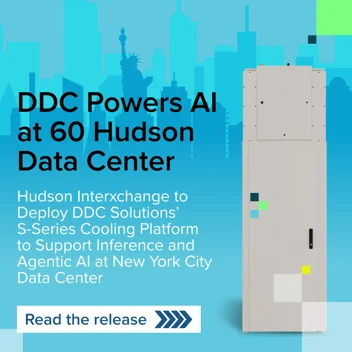
DDC’s S-Series takes a radical departure from that model, offering a fully enclosed, self-contained cabinet that redefines how infrastructure is deployed and protected. This blog dives into the architecture behind the “data center in a box” approach—and why it’s resonating with modern IT teams.
Reinventing the Rack
The S-Series doesn’t rely on traditional infrastructure to function. Instead of using open racks within room-wide thermal control systems, each S-Series cabinet houses its own closed-loop airflow and integrated cooling. The enclosure is fully sealed from the surrounding environment, meaning no reliance on hot or cold aisle containment and no exposure to room-level contaminants or humidity fluctuations.
Why That Matters
Self-containment allows the S-Series to operate in a more predictable thermal envelope. By isolating the cabinet from ambient conditions, DDC delivers more efficient, scalable cooling that doesn’t depend on data hall design. This has implications for both energy efficiency and environmental flexibility—including outdoor deployment.
Built to Withstand Harsh Environments
The S-Series is NEMA 3R rated, making it suitable for both indoor and outdoor use. That’s a significant differentiator. It means hyperscale-grade equipment can be deployed at the edge, closer to users and data sources, without compromising safety or performance.
Localized Fire Suppression
Every S-Series cabinet includes its own fire suppression system. This is not only safer—it’s more economical. Room-level suppression systems can cost tens or hundreds of thousands to refill after a single activation. DDC’s per-cabinet system uses a mechanical FK5-1-12 agent that aerosolizes upon heat activation, extinguishing fires without residue or collateral damage.
Thomas Demitras, VP of Engineering at DDC, notes: “The S-Series quite literally is a data center in a box. It’s not just hot or cold aisle containment—we’ve brought the entire data center environment down to the rack level.”
Security and Serviceability in One
With no exposure to ambient air, equipment within the S-Series is better protected from dust, humidity, and temperature swings. For service providers, this means fewer hardware failures and lower maintenance overhead. For hyperscale customers, it means a more predictable operating environment.
CapEx and OpEx Gains
The integrated design also eliminates the need for many traditional facility features:
- No raised floors are required (although we can still put the cabinets on one)
- No aisle containment buildouts
- Reduced HVAC complexity
- More precise airflow and thermal management
That translates into significant cost savings—not just in initial buildouts but in long-term operational expenses.
Built for Any Deployment Model
The S-Series supports both roll-in and rack-and-stack server configurations. With the rise of pre-populated racks from vendors like Dell and Supermicro, roll-in installations are now preferred by 90% of DDC customers. This trend simplifies data center deployments and accelerates time to value.
Condensation Control: Designed with ASHRAE in Mind
The closed nature of the S-Series introduces questions about condensation. DDC recommends maintaining ASHRAE’s environmental guidelines (e.g., 50% humidity at 81°F) and has developed features like dew point tracking and optional dehumidification modules for field-deployed units.
Integrated DCIM Visibility
The S-Series integrates into DDC’s DCIM platform, which offers real-time environmental monitoring—dew point, coil temperature, humidity, and more—helping facilities avoid downtime and optimize thermal control.
Built for the Edge and the Hyperscale Future
DDC is already working with customers to create drop-in modular data centers: three-container setups with pre-racked S-Series cabinets, a power generation module, and an external chiller skid. These systems can be deployed anywhere—ideal for universities, telecoms, healthcare, and other latency-sensitive edge applications.
Learn more about the S-Series and see how modularity can future-proof your data center.